
Opening the Vault at the
Presidential Libraries
Museum Special Gallery
June 2 – July 5, 2026
In celebration of the 250th anniversary of the American Declaration of Independence, the National Archives is partnering with Presidential Libraries to present some of the most significant documents in United States history. These iconic and historically valuable records highlight the people and moments that have shaped our nation.
The Eisenhower Presidential Library and Museum is proud to host this landmark stop on the tour, bringing original records from the vaults of the National Archives and Records Administration — works rarely displayed outside Washington, DC — to Abilene, Kansas. Guests will have the rare opportunity to stand face-to-face with some of the most renowned documents in our national story.
The Featured Documents
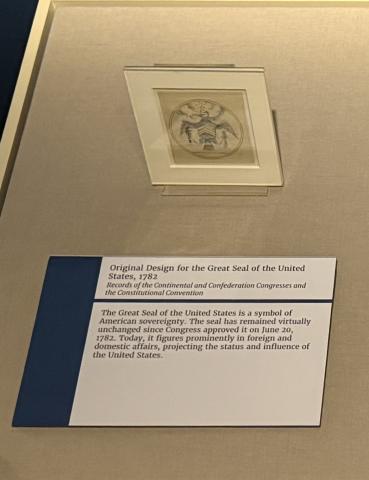
The Great Seal of the United States is a symbol of American sovereignty. The seal has remained virtually unchanged since Congress approved it on June 20, 1782. Today, it figures prominently in foreign and domestic affairs, projecting the status and influence of the United States.
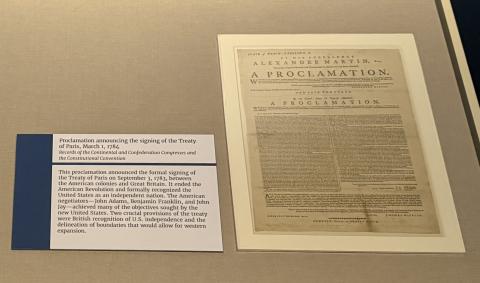
This proclamation announced the formal signing of the Treaty of Paris on September 3, 1783, between the American colonies and Great Britain. It ended the American Revolution and formally recognized the United States as an independent nation. The American negotiators—John Adams, Benjamin Franklin, and John Jay—achieved many of the objectives sought by the new United States. Two crucial provisions of the treaty were British recognition of U.S. independence and the delineation of boundaries that would allow for western expansion.
The first 10 amendments to the Constitution, known collectively as the Bill of Rights, secure the fundamental rights that Americans believe belong to all free people. This draft contains most of the final text of the Bill of Rights, including edits to the religion clauses of the First Amendment. In this draft, those changes appear in Article the Third, which later became the First Amendment.
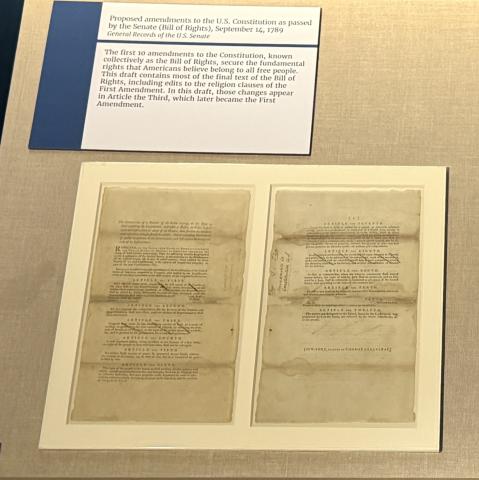
TRANSCRIPT - Bill of Rights proposed amendments
Congress of the United States
begun and held at the City of New-York, on
Wednesday the fourth of March, one thousand seven hundred and eighty nine.
THE Conventions of a number of the States, having at the time of their adopting the Constitution, expressed a desire, in order to prevent misconstruction or abuse of its powers, that further declaratory and restrictive clauses should be added: And as extending the ground of public confidence in the Government, will best ensure the beneficent ends of its institution.
RESOLVED by the Senate and House of Representatives of the United States of America, in Congress assembled, two thirds of both Houses concurring, that the following Articles be proposed to the Legislatures of the several States, as amendments to the Constitution of the United States, all, or any of which Articles, when ratified by three fourths of the said Legislatures, to be valid to all intents and purposes, as part of the said Constitution; viz.
ARTICLES in addition to, and Amendment of the Constitution of the United States of America, proposed by Congress, and ratified by the Legislatures of the several States, pursuant to the fifth Article of the original Constitution.
Article the first… After the first enumeration required by the first article of the Constitution, there shall be one Representative for every thirty thousand, until the number shall amount to one hundred, after which the proportion shall be so regulated by Congress, that there shall be not less than one hundred Representatives, nor less than one Representative for every forty thousand persons, until the number of Representatives shall amount to two hundred; after which the proportion shall be so regulated by Congress, that there shall not be less than two hundred Representatives, nor more than one Representative for every fifty thousand persons.
Article the second… No law, varying the compensation for the services of the Senators and Representatives, shall take effect, until an election of Representatives shall have intervened.
Article the third… Congress shall make no law respecting an establishment of religion, or prohibiting the free exercise thereof; or abridging the freedom of speech, or of the press; or the right of the people peaceably to assemble, and to petition the Government for a redress of grievances.
Article the fourth… A well regulated Militia, being necessary to the security of a free State, the right of the people to keep and bear Arms, shall not be infringed.
Article the fifth… No Soldier shall, in time of peace be quartered in any house, without the consent of the Owner, nor in time of war, but in a manner to be prescribed by law.
Article the sixth… The right of the people to be secure in their persons, houses, papers, and effects, against unreasonable searches and seizures, shall not be violated, and no Warrants shall issue, but upon probable cause, supported by Oath or affirmation, and particularly describing the place to be searched, and the persons or things to be seized.
Article the seventh… No person shall be held to answer for a capital, or otherwise infamous crime, unless on a presentment or indictment of a Grand Jury, except in cases arising in the land or naval forces, or in the Militia, when in actual service in time of War or public danger; nor shall any person be subject for the same offence to be twice put in jeopardy of life or limb; nor shall be compelled in any criminal case to be a witness against himself, nor be deprived of life, liberty, or property, without due process of law; nor shall private property be taken for public use, without just compensation.
Article the eighth… In all criminal prosecutions, the accused shall enjoy the right to a speedy and public trial, by an impartial jury of the State and district wherein the crime shall have been committed, which district shall have been previously ascertained by law, and to be informed of the nature and cause of the accusation; to be confronted with the witnesses against him; to have compulsory process for obtaining witnesses in his favor, and to have the Assistance of Counsel for his defence.
Article the ninth… In suits at common law, where the value in controversy shall exceed twenty dollars, the right of trial by jury shall be preserved, and no fact tried by a jury, shall be otherwise re-examined in any Court of the United States, than according to the rules of the common law.
Article the tenth… Excessive bail shall not be required, nor excessive fines imposed, nor cruel and unusual punishments inflicted.
Article the eleventh… The enumeration in the Constitution, of certain rights, shall not be construed to deny or disparage others retained by the people.
Article the twelfth… The powers not delegated to the United States by the Constitution, nor prohibited by it to the States, are reserved to the States respectively, or to the people.
ATTEST,
Frederick Augustus Muhlenberg, Speaker of the House of Representatives
John Adams, Vice-President of the United States, and President of the Senate
John Beckley, Clerk of the House of Representatives.
Sam. A Otis Secretary of the Senate
In this transaction with France, signed on April 30, 1803, the United States purchased 828,000 square miles of land west of the Mississippi River for $15 million. For roughly four cents an acre, the U.S. doubled its size, expanding the nation westward.
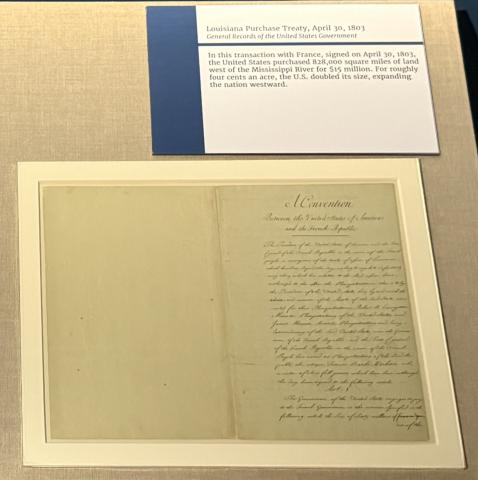
TRANSCRIPT - Louisiana Purchase
TREATY BETWEEN THE UNITED STATES OF AMERICA AND THE FRENCH REPUBLIC
The President of the United States of America and the First Consul of the French Republic in the name of the French People desiring to remove all Source of misunderstanding relative to objects of discussion mentioned in the Second and fifth articles of the Convention of the 8th Vendémiaire an 9 (30 September 1800) relative to the rights claimed by the United States in virtue of the Treaty concluded at Madrid the 27 of October 1795, between His Catholic Majesty & the Said United States, & willing to Strengthen the union and friendship which at the time of the Said Convention was happily reestablished between the two nations have respectively named their Plenipotentiaries to wit The President of the United States, by and with the advice and consent of the Senate of the Said States; Robert R. Livingston Minister Plenipotentiary of the United States and James Monroe Minister Plenipotentiary and Envoy extraordinary of the Said States near the Government of the French Republic; And the First Consul in the name of the French people, Citizen Francis Barbé Marbois Minister of the public treasury who after having respectively exchanged their full powers have agreed to the following Articles.
Article I
Whereas by the Article the third of the Treaty concluded at St Ildefonso the 9th Vendémiaire an 9 (1st October) 1800 between the First Consul of the French Republic and his Catholic Majesty it was agreed as follows.
“His Catholic Majesty promises and engages on his part to cede to the French Republic six months after the full and entire execution of the conditions and Stipulations herein relative to his Royal Highness the Duke of Parma, the Colony or Province of Louisiana with the Same extent that it now has in the hand of Spain, & that it had when France possessed it; and Such as it Should be after the Treaties subsequently entered into between Spain and other States.”
And whereas in pursuance of the Treaty and particularly of the third article the French Republic has an incontestible title to the domain and to the possession of the said Territory–The First Consul of the French Republic desiring to give to the United States a strong proof of his friendship doth hereby cede to the United States in the name of the French Republic for ever and in full Sovereignty the said territory with all its rights and appurtenances as fully and in the Same manner as they have been acquired by the French Republic in virtue of the above mentioned Treaty concluded with his Catholic Majesty.
Article: II
In the cession made by the preceeding article are included the adjacent Islands belonging to Louisiana all public lots and Squares, vacant lands and all public buildings, fortifications, barracks and other edifices which are not private property.–The Archives, papers & documents relative to the domain and Sovereignty of Louisiana and its dependances will be left in the possession of the Commissaries of the United States, and copies will be afterwards given in due form to the Magistrates and Municipal officers of such of the said papers and documents as may be necessary to them.
Article: III
The inhabitants of the ceded territory shall be incorporated in the Union of the United States and admitted as soon as possible according to the principles of the federal Constitution to the enjoyment of all these rights, advantages and immunities of citizens of the United States, and in the mean time they shall be maintained and protected in the free enjoyment of their liberty, property and the Religion which they profess.
Article: IV
There Shall be Sent by the Government of France a Commissary to Louisiana to the end that he do every act necessary as well to receive from the Officers of his Catholic Majesty the Said country and its dependances in the name of the French Republic if it has not been already done as to transmit it in the name of the French Republic to the Commissary or agent of the United States.
Article: V
Immediately after the ratification of the present Treaty by the President of the United States and in case that of the first Consul’s shall have been previously obtained, the commissary of the French Republic shall remit all military posts of New Orleans and other parts of the ceded territory to the Commissary or Commissaries named by the President to take possession–the troops whether of France or Spain who may be there shall cease to occupy any military post from the time of taking possession and shall be embarked as soon as possible in the course of three months after the ratification of this treaty.
Article: VI
The United States promise to execute Such treaties and articles as may have been agreed between Spain and the tribes and nations of Indians until by mutual consent of the United States and the said tribes or nations other Suitable articles Shall have been agreed upon.
Article: VII
As it is reciprocally advantageous to the commerce of France and the United States to encourage the communication of both nations for a limited time in the country ceded by the present treaty until general arrangements relative to commerce of both nations may be agreed on; it has been agreed between the contracting parties that the French Ships coming directly from France or any of her colonies loaded only with the produce and manufactures of France or her Said Colonies; and the Ships of Spain coming directly from Spain or any of her colonies loaded only with the produce or manufactures of Spain or her Colonies shall be admitted during the Space of twelve years in the Port of New-Orleans and in all other legal ports-of-entry within the ceded territory in the Same manner as the Ships of the United States coming directly from France or Spain or any of their Colonies without being Subject to any other or greater duty on merchandize or other or greater tonnage than that paid by the citizens of the United States.
During that Space of time above mentioned no other nation Shall have a right to the Same privileges in the Ports of the ceded territory–the twelve years Shall commence three months after the exchange of ratifications if it Shall take place in France or three months after it Shall have been notified at Paris to the French Government if it Shall take place in the United States; It is however well understood that the object of the above article is to favour the manufactures, Commerce, freight and navigation of France and of Spain So far as relates to the importations that the French and Spanish Shall make into the Said Ports of the United States without in any Sort affecting the regulations that the United States may make concerning the exportation of the produce and merchandize of the United States, or any right they may have to make Such regulations.
Article: VIII
In future and for ever after the expiration of the twelve years, the Ships of France shall be treated upon the footing of the most favoured nations in the ports above mentioned.
Article: IX
The particular Convention Signed this day by the respective Ministers, having for its object to provide for the payment of debts due to the Citizens of the United States by the French Republic prior to the 30th Sept. 1800 (8th Vendémiaire an 9) is approved and to have its execution in the Same manner as if it had been inserted in this present treaty, and it Shall be ratified in the same form and in the Same time So that the one Shall not be ratified distinct from the other.
Another particular Convention Signed at the Same date as the present treaty relative to a definitive rule between the contracting parties is in the like manner approved and will be ratified in the Same form, and in the Same time and jointly.
Article: X
The present treaty Shall be ratified in good and due form and the ratifications Shall be exchanged in the Space of Six months after the date of the Signature by the Ministers Plenipotentiary or Sooner if possible.
In faith whereof the respective Plenipotentiaries have Signed these articles in the French and English languages; declaring nevertheless that the present Treaty was originally agreed to in the French language; and have thereunto affixed their Seals.
Done at Paris the tenth day of Floreal in the eleventh year of the French Republic; and the 30th of April 1803.
Robt R Livingston [seal]
Jas. Monroe [seal]
Barbé Marbois [seal]
A CONVENTION BETWEEN
THE UNITED STATES OF AMERICA
AND THE FRENCH REPUBLIC
The President of the United States of America and the First Consul of the French Republic in the name of the French people, in consequence of the treaty of cession of Louisiana which has been Signed this day; wishing to regulate definitively every thing which has relation to the Said cession have authorized to this effect the Plenipotentiaries, that is to say the President of the United States has, by and with the advice and consent of the Senate of the Said States, nominated for their Plenipoten tiaries, Robert R. Livingston, Minister Plenipotentiary of the United States, and James Monroe, Minister Plenipotentiary and Envoy-Extraordinary of the Said United States, near the Government of the French Republic; and the First Consul of the French Republic, in the name of the French people, has named as Pleniopotentiary of the Said Republic the citizen Francis Barbé Marbois: who, in virtue of their full powers, which have been exchanged this day, have agreed to the followings articles:
Article: 1
The Government of the United States engages to pay to the French government in the manner Specified in the following article the sum of Sixty millions of francs independant of the Sum which Shall be fixed by another Convention for the payment of the debts due by France to citizens of the United States.
Article: 2
For the payment of the Sum of Sixty millions of francs mentioned in the preceeding article the United States shall create a Stock of eleven millions, two hundred and fifty thousand Dollars bearing an interest of Six percent per annum payable half yearly in London Amsterdam or Paris amounting by the half year to three hundred and thirty Seven thousand five hundred Dollars, according to the proportions which Shall be determined by the french Govenment to be paid at either place: The principal of the Said Stock to be reimbursed at the treasury of the United States in annual payments of not less than three millions of Dollars each; of which the first payment Shall commence fifteen years after the date of the exchange of ratifications:–this Stock Shall be transferred to the government of France or to Such person or persons as Shall be authorized to receive it in three months at most after the exchange of ratifications of this treaty and after Louisiana Shall be taken possession of the name of the Government of the United States.
It is further agreed that if the french Government Should be desirous of disposing of the Said Stock to receive the capital in Europe at Shorter terms that its measures for that purpose Shall be taken So as to favour in the greatest degree possible the credit of the United States, and to raise to the highest price the Said Stock.
Article 3
It is agreed that the Dollar of the United States Specified in the present Convention shall be fixed at five francs 3333/100000 or five livres eight Sous tournois.
The present Convention Shall be ratified in good and due form, and the ratifications Shall be exchanged the Space of Six months to date from this day or Sooner it possible.
In faith of which the respective Plenipotentiaries have Signed the above articles both in the french and english languages, declaring nevertheless that the present treaty has been originally agreed on and written in the french language; to which they have hereunto affixed their Seals.
Done at Paris the tenth of Floreal eleventh year of the french Republic
30th April 1803 .
Robt R Livingston [seal]
Jas. Monroe [seal]
Barbé Marbois [seal]
The admission of Missouri to the Union as a slave state in 1819 created controversy over the balance of power between slave and free states. This compromise legislation admitted Missouri as a slave state. To maintain the balance, Maine was admitted as a free state. The legislation also outlawed slavery above the 36º 30’ latitude line in the remainder of the Louisiana Territory. This provision was in place for 34 years until it was repealed by the Kansas-Nebraska Act of 1854, which decided the issue of slavery in new territories by popular sovereignty.

TRANSCRIPT - Missouri Compromise (1820) Conference Committee Report
The committee of conference of the Senate and of the House of Representatives on the subject of the disagreeing votes of the Two Houses, upon the Bill entitled an “Act for the admission of the State of Maine into the Union”–
Report the following Resolution.
Resolved.
1st That they recommend to the Senate to recede from their amendment to the said Bill
2d That they recommend to the two Houses to agree to strike out of the fourth section of the Bill from the House of Representatives now pending in the Senate, entitled an “Act to authorize the people of the Missouri Territory to form a constitution and state government and for the admission of such State into the Union upon an equal footing with the original States” The following proviso in the following words–
and shall ordain and establish, that there shall be neither Slavery nor involuntary Servitude otherwise than in the punishment of crimes whereof the party shall have been duly convicted: provided, always, That any person escaping into the same, from whom labor or service is lawfully claimed in any other State, such fugitive may be lawfully reclaimed, and conveyed to the person claiming his or her labour or service, as aforesaid: Provided nevertheless, That the said Provision shall not be construed to alter the condition or civil rights of any person now held to service or labor, in the said Territory”–
And that the following provision be added to the Bill–
And be it further enacted, That in all that Territory ceded by France to the United States under the name of Louisiana, which lies north of thirty six degrees and thirty minutes north latitude not included within the limits of the State contemplated by this act, Slavery and involuntary Servitude otherwise than in the punishment of crimes whereof the party shall have been duly convicted, shall be and is hereby forever prohibited–Provided, always, That any person escaping into the same from whom labour or service is lawfully claimed in any other State or Territory of the United States, such fugitive may be lawfully reclaimed, and conveyed to the person claiming his or her labour or service as aforesaid.
The Compromise of 1850 addressed the expansion of slavery into new territories acquired in the Mexican-American War. Senator Henry Clay proposed a series of resolutions designed to “adjust amicably all existing questions of controversy . . . arising out of the institution of slavery.”

TRANSCRIPT - Henry Clay's handwritten draft of the Compromise of 1850
It being desirable, for the peace, concord, and harmony of the Union of these States, to settle and adjust amicably all existing questions of controversy between them arising out of the institution of slavery upon a fair, equitable and just basis: therefore,
1. Resolved, That California, with suitable boundaries, ought, upon her application to be admitted as one of the States of this Union, without the imposition by Congress of any restriction in respect to the exclusion or introduction of slavery within those boundaries.
2. Resolved, That as slavery does not exist by law, and is not likely to be introduced into any of the territory acquired by the United States from the republic of Mexico, it is inexpedient for Congress to provide by law either for its introduction into, or exclusion from, any part of the said territory; and that appropriate territorial governments ought to be established by Congress in all of the said territory, not assigned as the boundaries of the proposed State of California, without the adoption of any restriction or condition on the subject of slavery.
3. Resolved, That the western boundary of the State of Texas ought to be fixed on the Rio del Norte, commencing one marine league from its mouth, and running up that river to the southern line of New Mexico; thence with that line eastwardly, and so continuing in the same direction to the line as established between the United States and Spain, exclud- ing any portion of New Mexico, whether lying on the east or west of that river.
4. Resolved, That it be proposed to the State of Texas, that the United States will provide for the payment of all that portion of the legitimate and bona fide public debt of that State contracted prior to its annexation to the United States, and for which the duties on foreign imports were pledged by the said State to its creditors, not exceeding the sum of dollars, in consideration of the said duties so pledged having been no longer applicable to that object after the said annexa- tion, but having thenceforward become pay- able to the United States; and upon the condition, also, that the said State of Texas shall, by some solemn and authentic act of her legislature or of a convention, relinquish to the United States any claim which it has to any part of New Mexico.
5. Resolved, That it is inexpedient to abolish slavery in the District of Columbia whilst that institution continues to exist in the State of Maryland, without the consent of that State, without the consent of the people of the District, and without just compensation to the owners of slaves within the District.
6. But, resolved, That it is expedient to prohibit, within the District, the slave trade in slaves brought into it from States or places beyond the limits of the District, either to be sold therein as merchandise, or to be trans- ported to other markets without the District of Columbia.
7. Resolved, That more effectual provision ought to be made by law, according to the requirement of the constitution, for the restitution and delivery of persons bound to service or labor in any State, who may escape into any other State or Territory in the Union. And,
8. Resolved, That Congress has no power to promote or obstruct the trade in slaves between the slaveholding States; but that the admission or exclusion of slaves brought from one into another of them, depends exclusively upon their own particular laws.
The admission of Missouri to the Union as a slave state in 1819 created controversy over the balance of power between slave and free states. This compromise legislation admitted Missouri as a slave state. To maintain the balance, Maine was admitted as a free state. The legislation also outlawed slavery above the 36º 30’ latitude line in the remainder of the Louisiana Territory. This provision was in place for 34 years until it was repealed by the Kansas-Nebraska Act of 1854, which decided the issue of slavery in new territories by popular sovereignty.
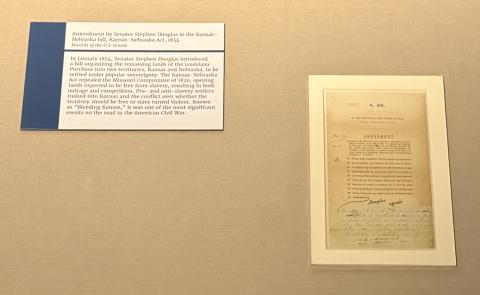
TRANSCRIPT - Kansas-Nebraska Act
33rd Congress, 1st Session.
S. 22.
IN THE SENATE OF THE UNITED STATES.
February 7, 1854.--Ordered to be printed.
Page 34–sec. 34 AMENDMENT
Proposed by Mr. Douglas to his amendment, submitted the twenty-third of January, to the bill [S. 22] “to organize the Territory of Nebraska,” viz: Section 3 of the amendment, lines 22, 23, 24, and 25, strike out the words “which was superseded by the principles of the legislation of eighteen hundred and fifty, commonly called the Compromise Measures, and is hereby declared inoperative,” and insert:
22 Which, being inconsistent with the principle of non-interven-
23 tion by Congress with slavery in the States and Territories,
24 as recognized by the legislation of eighteen hundred and fifty,
25 (commonly called the Compromise measures) is hereby de-
26 clared inoperative and void; it being the true intent and mean-
27 ing of this act not to legislate slavery into any Territory or
28 State, nor to exclude it therefrom, but to leave the people
29 thereof perfectly free to form and regulate their domestic insti-
30 tutions in their own way, subject only to the Constitution of the
31 United States.
Douglas agreed
Provided, that nothing herein contained shall be construed to revive or put in force any law or regulation which may have existed prior to the act of 6 March 1820, whether protecting, establishing, prohibiting, or abolishing slavery
Badger to add to Douglas amendment.
agreed Kansas agreed
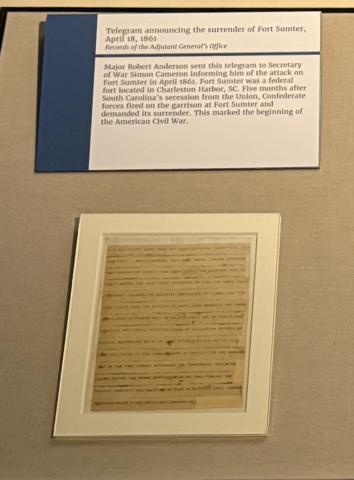
Major Robert Anderson sent this telegram to Secretary of War Simon Cameron informing him of the attack on Fort Sumter in April 1861. Fort Sumter was a federal fort located in Charleston Harbor, SC. Five months after South Carolina’s secession from the Union, Confederate forces fired on the garrison at Fort Sumter and demanded its surrender. This marked the beginning of the American Civil War.
The 13th Amendment, abolishing slavery in the United States, was passed by Congress on January 31, 1865. Although Presidents typically do not sign Congressional resolutions, President Abraham Lincoln signed the joint resolution submitting the proposed amendment to the state legislatures. The necessary number of states (three-fourths) ratified it by December 6, 1865
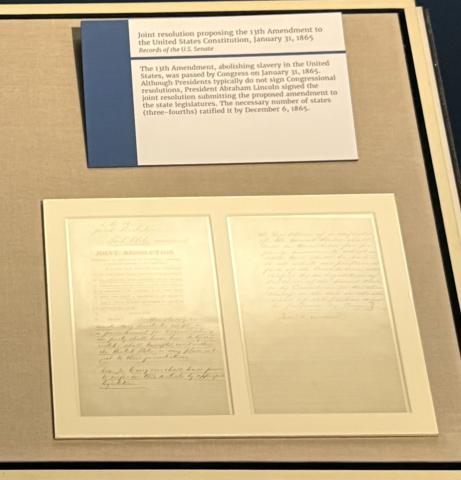
TRANSCRIPT - 13th Amendment
S. R. 16
Joint Resolution.
[crossed out: Substitute] amendment
[typed text adhered to document]
[crossed out: Joint Resolution]
Submitting to the legislatures of the several States a proposition to amend the Constitution of the United States.
[italics] Be it enacted by the Senate and House of Representatives of the United States of America in Congress assembled, [end italics] (two-thirds of both houses concurring,) That the following article be proposed to the legislatures of the several States as an amendment to the Constitution of the United States, which, when ratified by three-fourths of said legislatures, shall be valid, to all intents and purposes, as a part of the said Constitution, namely:
Article XIII.
Section 1. [handwritten] Neither slaver nor involuntary servitude, except as a punishment for crime whereof the party shall have been duly convicted, shall [crossed out: hereafter] exist within the United States, or any place subject to their jurisdiction.
Sec. 2 Congress shall have power to enforce this article by appropriate legislation.
S.R. 16
Joint Resolution
[horizontal line]
Substitute
Amendment
Passed by Congress on June 13, 1866, and ratified July 9, 1868, the 14th Amendment extended liberties and rights granted by the Bill of Rights to formerly enslaved people. This amendment provided for a constitutional guarantee of birthright citizenship for all, federal protection of due process, and the mandate for equal protection under the law.
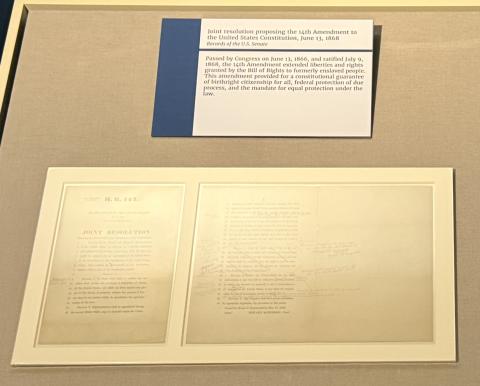
TRANSCRIPT - 14th Amendment
Article XIV
Section 1. All persons born or naturalized in the United States, and subject to the jurisdiction thereof, are citizens of the United States and of the State wherein they reside. No State shall make or enforce any law which shall abridge the privileges or immunities of citizens of the United States; nor shall any State deprive any person of life, liberty, or property, without due process of law; nor deny to any person within its jurisdiction the equal protection of the laws.
Section 2. Representatives shall be apportioned among the several States according to their respective numbers, counting the whole number of persons in each State, excluding Indians not taxed. But when the right to vote at any election for the choice of electors for President and Vice-President of the United States, Representatives in Congress, the Executive and Judicial officers of a State, or the members of the Legislature thereof, is denied to any of the male inhabitants of such State, being twenty-one years of age, and citizens of the United States, or in any way abridged, except for participation in rebellion, or other crime, the basis of representation therein shall be reduced in the proportion which the
number of such male citizens shall bear to the whole number of male citizens twenty-one years of age in such State.
Section 3. No person shall be a Senator or Representative in Congress, or elector of President and Vice-President, or hold any office, civil or military, under the United States, or under any State, who, having previously taken an oath, as a member of Congress, or as an officer of the United States, or as a member of any State legislature, or as an executive or judicial officer of any State, to support the Constitution of the United States, shall have engaged in insurrection or rebellion against the same, or given aid or comfort to the enemies thereof. But Congress may by a vote of two-thirds of each House, remove such disability.
Section 4. The validity of the public debt of the United States, authorized by law, including debts incurred for payment of pensions and bounties for services in suppressing insurrection or rebellion, shall not be questioned. But neither the United States nor any State shall assume or pay any debt or obligation incurred in aid of insurrection or rebellion against the United States, or any claim for the loss or emancipation of any slave; but all such debts, obligations and claims shall be held illegal and void.
Section 5. The Congress shall have the power to enforce, by appropriate legislation, the provisions of this article.
This landmark Supreme Court case stemmed from a Louisiana law that required separate accommodations for white and black passengers on railroads. This ruling introduced the doctrine of “separate but equal,” establishing a legal foundation for racial segregation that would stand until struck down by Brown v. Board of Education of Topeka in 1954.
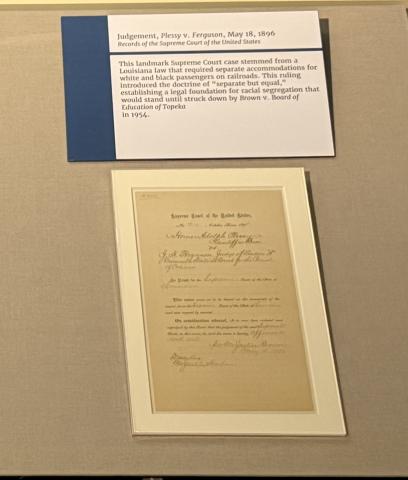
TRANSCRIPT - Judgement, Plessy v. Ferguson
Supreme Court of the United States, No. 210, October Term, 1895.
Homer Adolph Plessy, Plaintiff in Error, vs. J. H. Ferguson, Judge of Section “A”
Criminal District Court for the Parish of Orleans.
In Error to the Supreme Court of the State of Louisiana
This cause came on to be heard on the transcript of the record from the Supreme Court of the State of Louisiana, and was argued by counsel.
On consideration whereof, It is now here ordered and adjudged by this Court that the judgement of the said Supreme Court, in this cause, be, and the same is hereby, affirmed with costs.
per Mr. Justice Brown,
May 18, 1896.
Dissenting: Mr. Justice Harlan
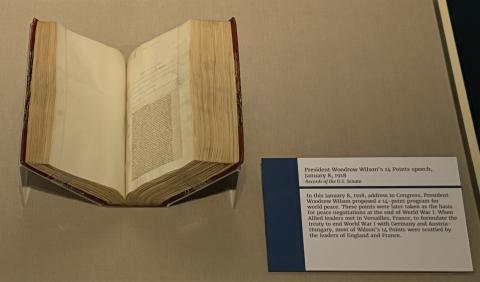
In this January 8, 1918, address to Congress, President Woodrow Wilson proposed a 14-point program for world peace. These points were later taken as the basis for peace negotiations at the end of World War I. When Allied leaders met in Versailles, France, to formulate the treaty to end World War I with Germany and Austria-Hungary, most of Wilson’s 14 Points were scuttled by the leaders of England and France.
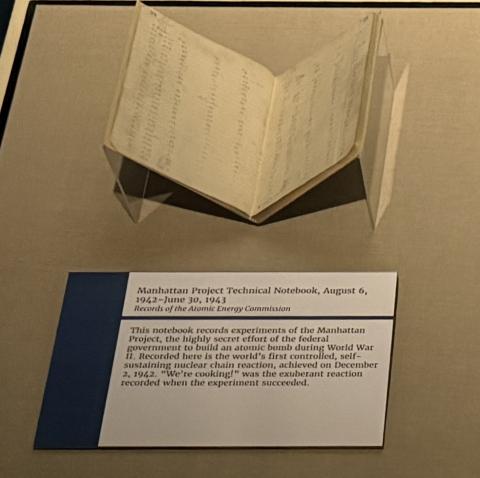
This notebook records experiments of the Manhattan Project, the highly secret effort of the federal government to build an atomic bomb during World War II. Recorded here is the world’s first controlled, self-sustaining nuclear chain reaction, achieved on December2, 1942. “We’re cooking!” was the exuberant reaction recorded when the experiment succeeded.
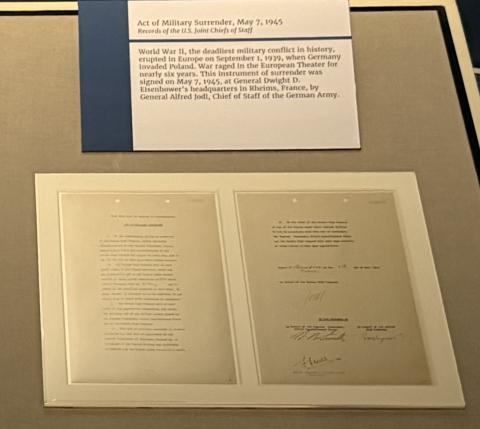
World War II, the deadliest military conflict in history, erupted in Europe on September 1, 1939, when Germany invaded Poland. War raged in the European Theater for nearly six years. This instrument of surrender was signed on May 7, 1945, at General Dwight D. Eisenhower’s headquarters in Rheims, France, by General Alfred Jodl, Chief of Staff of the German Army.
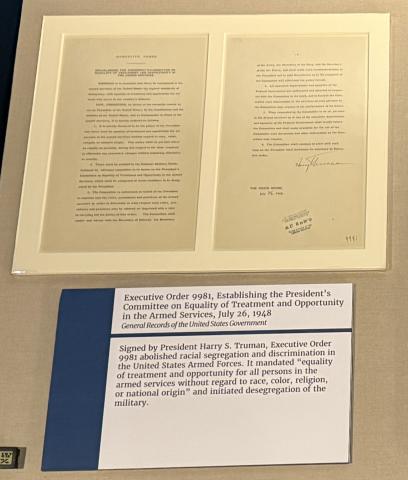
Signed by President Harry S. Truman, Executive Order 9981 abolished racial segregation and discrimination in the United States Armed Forces. It mandated “equality of treatment and opportunity for all persons in the armed services without regard to race, color, religion, or national origin” and initiated desegregation of the military.
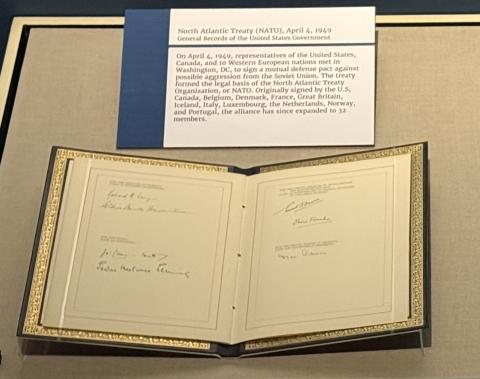
On April 4, 1949, representatives of the United States, Canada, and 10 Western European nations met in Washington, DC, to sign a mutual defense pact against possible aggression from the Soviet Union. The treaty formed the legal basis of the North Atlantic Treaty Organization, or NATO. Originally signed by the U.S, Canada, Belgium, Denmark, France, Great Britain, Iceland, Italy, Luxembourg, the Netherlands, Norway, and Portugal, the alliance has since expanded to 32 members.
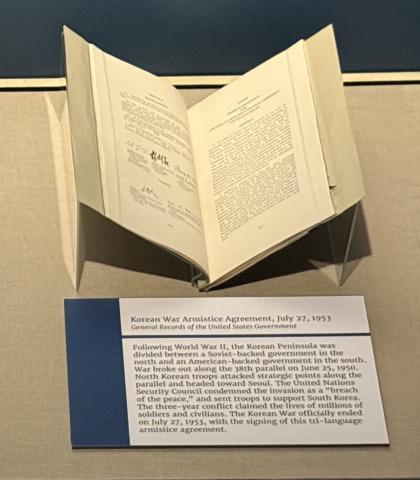
Following World War II, the Korean Peninsula was divided between a Soviet-backed government in the north and an American-backed government in the south. War broke out along the 38th parallel on June 25, 1950. North Korean troops attacked strategic points along the parallel and headed toward Seoul. The United Nations Security Council condemned the invasion as a “breach of the peace,” and sent troops to support South Korea. The three-year conflict claimed the lives of millions of soldiers and civilians. The Korean War officially ended on July 27, 1953, with the signing of this tri-language armistice agreement.
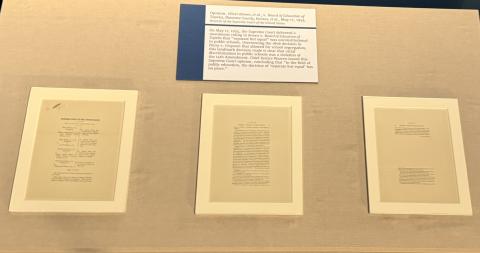
On May 17, 1954, the Supreme Court delivered a unanimous ruling in Brown v. Board of Education of Topeka that “separate but equal” was unconstitutional in public schools. Overturning the 1896 decision in Plessy v. Ferguson that allowed for school segregation, this landmark decision made it clear that racial discrimination in public schools was a violation of the 14th Amendment. Chief Justice Warren issued this Supreme Court opinion, concluding that “in the field of public education, the doctrine of ‘separate but equal’ has no place.”
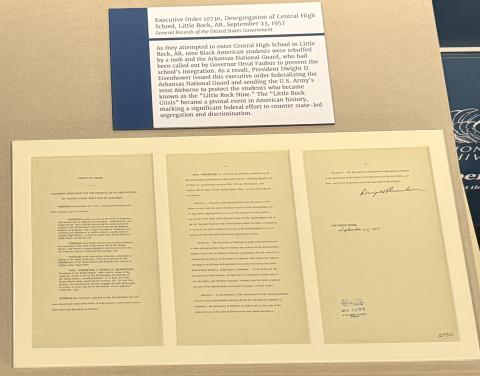
As they attempted to enter Central High School in Little Rock, AR, nine Black American students were rebuffed by a mob and the Arkansas National Guard, who had been called out by Governor Orval Faubus to prevent the school’s integration. As a result, President Dwight D. Eisenhower issued this executive order federalizing the Arkansas National Guard and sending the U.S. Army’s 101st Airborne to protect the students who became known as the “Little Rock Nine.” The “Little Rock Crisis” became a pivotal event in American history, marking a significant federal effort to counter state-led segregation and discrimination.
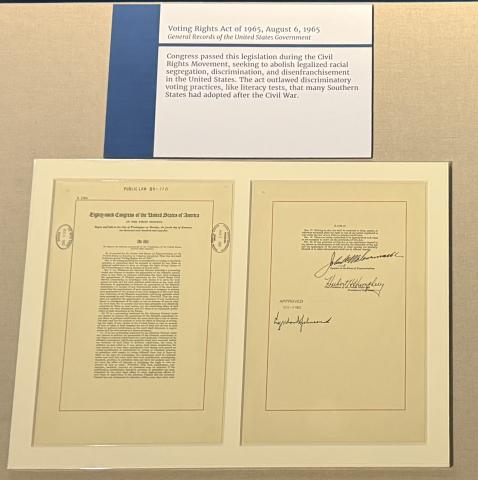
Congress passed this legislation during the Civil Rights Movement, seeking to abolish legalized racial segregation, discrimination, and disenfranchisement in the United States. The act outlawed discriminatory voting practices, like literacy tests, that many Southern States had adopted after the Civil War.
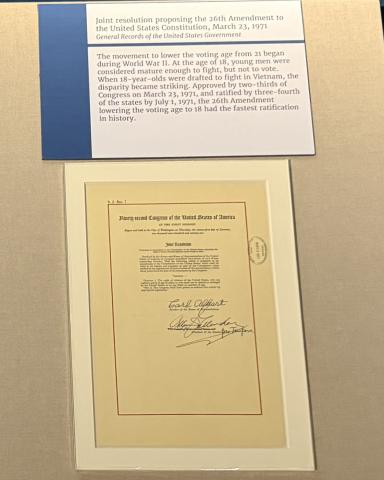
The movement to lower the voting age from 21 began during World War II. At the age of 18, young men were considered mature enough to fight, but not to vote. When 18-year-olds were drafted to fight in Vietnam, the disparity became striking. Approved by two-thirds of Congress on March 23, 1971, and ratified by three-fourth of the states by July 1, 1971, the 26th Amendment lowering the voting age to 18 had the fastest ratification in history.